INJURY CLINIC
STAY ON THE ROAD
Guides to six common running injuries: what each one feels like, what to do about it, and when to see someone.
RUNNER'S INJURY CHECK
HURTING? START HERE
Answer a couple of questions and get pointed toward the likely cause and the right next step.
WHERE DOES IT HURT?
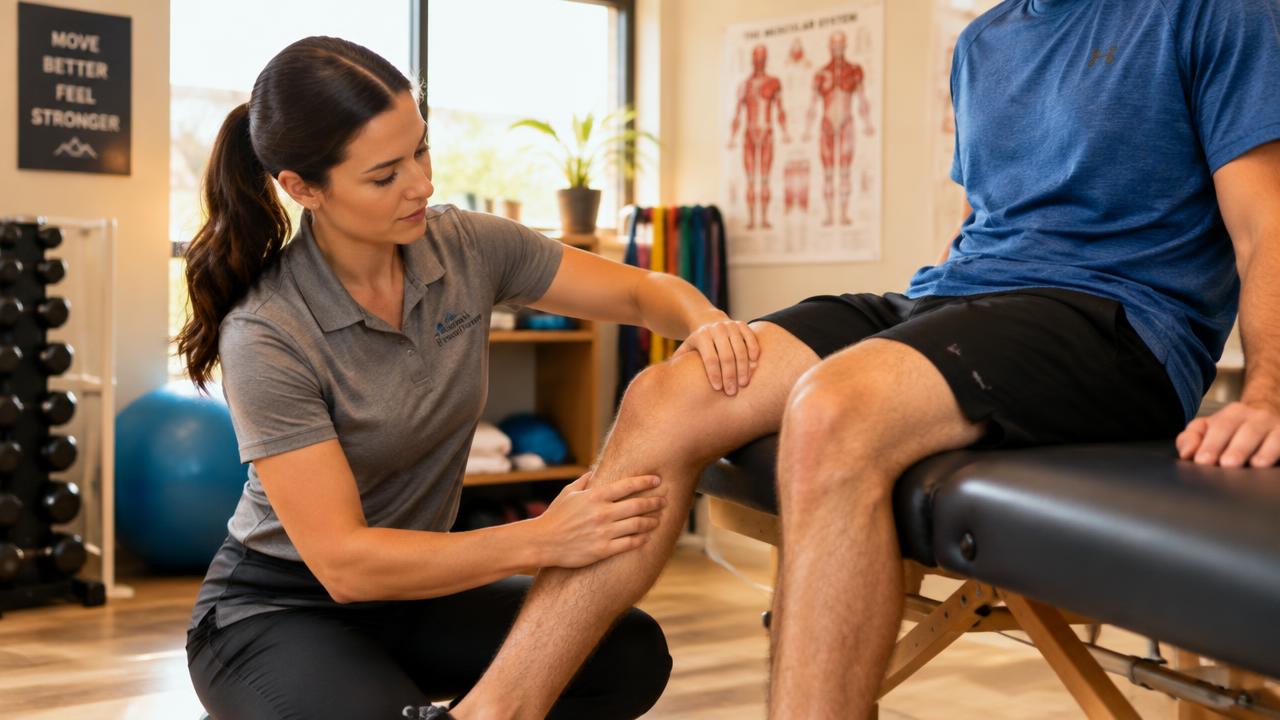
This is educational information, not medical advice. See a qualified healthcare professional for diagnosis and treatment of any injury. In Brooklyn? Dr. Craig Patane treats runners at Form & Function Chiropractic and Rehab.
Hurt? See Form & Function Chiropractic and Rehab in Brooklyn
Runner's Knee (Patellofemoral Pain)
Achy pain around or behind the kneecap, usually worse on stairs, hills, and after sitting. The most common injury in distance runners (Taunton et al., British Journal of Sports Medicine, 2002).
What it feels like
- Dull ache around the kneecap
- Pain going downstairs or downhill
- Stiffness after long sitting ('movie sign')
What to do
- Reduce mileage temporarily, and don't run through sharp pain
- Strengthen quads and hips (step-downs, side planks, clamshells)
- Check shoe mileage and consider a gait assessment
- Heat, or contrast therapy (alternating warm and cold), after runs can ease it. See a clinician if the knee swells, locks or gives way, or if pain lasts more than two to three weeks
Why it happens
- Adding mileage or hills too quickly
- Weak hips and glutes letting the knee drift inward
- Overstriding with a heavy heel strike
How to prevent it
- Strength work twice a week: side planks, clamshells, step downs, split squats
- Take shorter, quicker steps, about 10 percent more steps per minute, the increase tested in a 2019 study by Bramah and colleagues
- Grow weekly mileage gradually, and back off every third or fourth week
When to see a pro
See someone if the knee swells, locks, gives way, or if pain lasts more than two to three weeks with rest and strength work.
Getting back to running
Pain up to about 3 out of 10 during a run is usually fine if it settles by the next morning. Start on flat ground and save downhills and stairs for last.
Shin Splints (Medial Tibial Stress Syndrome)
Tenderness along the inner shin, common in new runners or after sudden mileage jumps. If you keep running on it as it gets worse, it can progress to a bone stress injury.
What it feels like
- Diffuse tenderness along the inner lower leg
- Pain at the start of a run that may fade, then return
- Soreness when pressing on the shin bone
What to do
- Cut your mileage and avoid speed work until the shin settles
- Run on softer surfaces where possible
- Calf raises and toe walks to build lower leg strength
- Sharp pain in one spot on the bone needs an exam, and sometimes imaging
Why it happens
- Sudden jumps in mileage, often at the start of a training block
- Lots of running on hard surfaces or a banked road
- Worn out shoes and weak calves
How to prevent it
- Calf raises, both straight and bent knee, three sets of 15
- Mix in softer surfaces like the Prospect Park bridle path or a track
- Check your shoes at 300 to 500 miles, a common rule of thumb
When to see a pro
If pain is in one small spot you can press with a fingertip, get checked for a stress fracture. Hopping on it is a screen only, never a diagnosis.
Getting back to running
Cross train for a week or two, then use run and walk intervals on soft ground.
Plantar Fasciitis
Stabbing heel pain with your first steps in the morning. Caused by overload of the thick band of tissue along the bottom of the foot.
What it feels like
- Heel pain worst with first steps after rest
- Pain that eases as you warm up, returns after
- Tenderness at the inside of the heel bone
What to do
- Calf and plantar fascia stretching, especially before first steps
- Roll the arch on a frozen bottle or lacrosse ball
- Avoid walking barefoot on hard floors during flare-ups
- Slow, heavy heel raises did better than stretching alone at three months in a 2015 trial of 48 people (Rathleff et al.), though the gap narrowed by twelve months
Why it happens
- Tight calves and a stiff Achilles
- Long hours standing or walking in flat shoes
- A fast increase in mileage or speed work
How to prevent it
- Daily calf stretching and slow heel raises off a step
- Supportive shoes around the house, especially first thing in the morning
- Roll the arch with a ball for a few minutes after runs
When to see a pro
Get evaluated if heel pain isn't improving, or if there is numbness, tingling or swelling.
Getting back to running
You can often keep running at lower volume if first step pain is improving week to week. Cut speed work and hills until mornings feel normal.
IT Band Syndrome
Sharp or burning pain on the outside of the knee, typically appearing at a predictable point into a run. Common when marathon mileage builds.
What it feels like
- Pain on the outer knee, often at the same distance each run
- Worse on downhills and cambered roads
- Tenderness just above the knee joint line
What to do
- Back off mileage and avoid downhill running temporarily
- Strengthen the hip abductors: side lying leg lifts, single leg squats
- Vary your route direction to even out road camber
Why it happens
- Long runs that grow too fast
- Running on the same side of a cambered road every time
- Weak hip stabilizers
How to prevent it
- Hip strength work: side lying leg raises, monster walks, single leg deadlifts
- Change direction on loops, or switch sides of the road
When to see a pro
See a physical therapist if pain stops you at the same point in every run for more than two weeks.
Getting back to running
Run only up to the point where pain starts, then stop. Grow that distance slowly. Flat routes first.
Achilles Tendinopathy
Stiffness and pain in the Achilles tendon, worst in the morning or at the start of a run. A classic overuse injury in runners adding hills or speed.
What it feels like
- Morning stiffness in the tendon that eases with movement
- Thickening or tenderness 2 to 6 cm above the heel
- Pain with hills, speed work, or jumping
What to do
- Isometric holds and progressive heel-raise loading
- Avoid aggressive stretching of the tendon early on
- Temporarily reduce hill repeats and intervals
- Don't ignore it. See a clinician if it isn't improving
Why it happens
- Adding hills, speed, or low drop shoes too fast
- Weak or tight calves
- Too little recovery between hard days
How to prevent it
- Heavy, slow calf raises three times a week
- Change shoes gradually and keep one pair with more heel drop in the rotation
- Keep at least one easy day between hard sessions
When to see a pro
Get help right away if you felt a pop or snap, or can't rise up onto your toes. Otherwise see someone if it isn't improving.
Getting back to running
Keep up the calf work, run on flat ground, and let morning stiffness guide how much you do.
Stress Fractures
A small crack in the bone from repetitive overload, most often the metatarsals, tibia, or navicular. Running through a stress fracture can turn a few weeks off into months.
What it feels like
- Pinpoint bone pain that worsens as the run goes on
- Pain when hopping on that leg. It is a screen, not a diagnosis: don't repeat it, and skip it if the pain is on top of the midfoot, at the base of the little toe, under the big toe or on the front of the shin
- Swelling or tenderness at a specific spot
What to do
- Stop running on it until you have been evaluated.
- Imaging may be needed. X-ray can miss early stress fractures, and MRI is more sensitive.
- Cross-train with pool running or cycling as tolerated
- Return gradually on the timeline your clinician sets, which depends on the bone and the scan
Why it happens
- Too much running too soon with too little recovery
- Not eating enough to fuel training
- Low vitamin D or calcium intake, and in women, missed periods, which can signal low energy intake
How to prevent it
- Eat enough to match your training, especially carbs and calcium
- Build mileage slowly and include rest days
- Pay attention to pain in one small spot that gets worse as you run
When to see a pro
Always. A suspected stress fracture needs a proper diagnosis and often imaging. Running through it can turn a few weeks off into months.
Getting back to running
Follow your clinician's timeline. Most runners start with walking, then run and walk intervals, over a period that depends on the bone.
A note from Craig: These guides are educational, not a diagnosis. If pain is sharp, getting worse, or changing how you move, get it looked at. I treat runners at Form & Function Chiropractic and Rehab in Brooklyn, and you can book an evaluation if you want a real plan for your injury.